

The First Honest Page
Because Real Change Begins With Honesty

Before anything can change, you have to stop pretending you already know who you are.
Most people try to build a new life on top of an old one — patching over cracks, rearranging the furniture, hoping momentum will make the foundation hold.
It never does.Real change begins with stillness. With looking. With the kind of honesty that doesn’t need to be public, only true.
And it all begins here: with a single blank page, a question that won’t leave you alone, and the courage to tell yourself the truth.
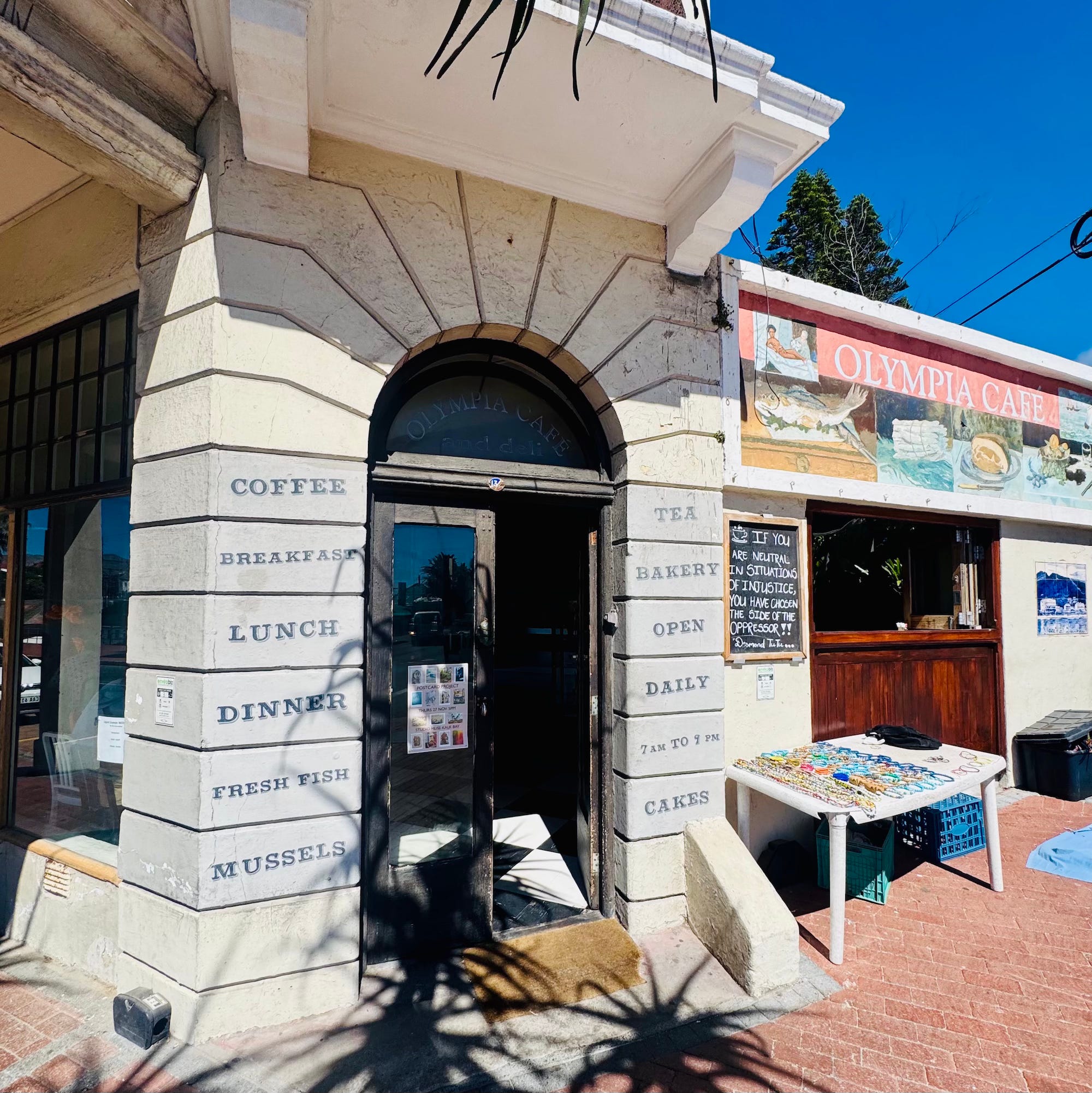
The Olympia Café was breathing like a machine—steam hissing, grinders complaining, plates touching down like a ceramic symphony. Locals and tourists writing their names on the blackboard at the entrance, desperate to snag a table and soak up the vibe of Kalk Bay’s notoriously not-so-well-kept secret. Noisy conversations filling the echoing walls of the rustic interior.
A former movie theater turned must-visit place when on the Cape Peninsula, this place isn’t just a café, it’s a stage. People come here to be seen, to hustle, to distract themselves from whatever they didn’t want to face. And I was one of them. Notebook open to a half-lived page. Ink started, stopped. Lines breaking mid-thought. If effort alone could make a map, I’d be across the African continent by now.
My pen hovering, pretending I had something to say. Truth was, I didn’t. Not yet.
“Mind if I steal this seat?” she asked, cradling a mug too large for her hand. Late 50s, unassuming, but her eyes—sharp, green, like they could see right through me.
“Sure,” I gestured, relieved by the interruption I pretended I didn’t want.
She settled next to me, eyes falling to the notebook the way a coach looks at a runner’s shoes.
“You a writer?”
“Not exactly,” I said, smirking. “More like a professional starter of things I don’t finish.”
She smiled like she’s heard the confession before. Then, calm as a weather report, she went on: “Imagine it’s one year from today. You’re back here, same table. What part of your old story would you be relieved to have shed?”
Boom. The question landed with the weight of a mirror. The room receded. A machine coughed. Somewhere behind us, a laugh of an American tourist cracked too loud and then ended abruptly. And for the first time in a long time, I didn’t have a clever answer.
She let the silence do its work. “What would your one-year-older self say to you right now?”
I offered her a deflection; it dissolved between us like foam on hot porcelain.
Her sharp eyes pinching me, until she cut the silence, in a timing Steven Spielberg couldn’t have directed better: “Here’s what I’ve seen,” she said, taking an easy sip from her mug. “People start backward. They set goals, chase outcomes, hope their discipline will drag them across a finish line—and then wonder why nothing sticks. Did you come into the Olympia through the back door? No, right? You came through the front” she pointed towards the entrance. “Reflection is that front door. Without it, you’re just running faster on the same treadmill.”
She rose with her mug and the practiced grace of someone who knows when to leave before the lesson curdles. “Or keep waiting for life to slow down,” she said, smiling. “But it won’t. Waiting is just another way of saying no. But, hey, you know that, don’t you?”
I must have looked like a school-boy. Mouth open, a mix of disbelief, maybe even rebellion and awe simultaneously, knowing that one day, I might be able to understand what she just said. Before I could say anything, she disappeared into the crowd, walked out of that wide open front door she just described, and the crowd kept being a crowd. The sentence she left behind, though, did not disappear. It sat across from me, heavier than the second cup I just got served. Asking to be picked up, the notebook waited. The blank page, asking for truth. I remember, I wrote three lines that felt like tearing a bandage:
I don’t know who I am anymore.
I’m tired of pretending I’m okay.
I’m afraid to stop running.
That was my wound underneath.
Honest, and open. Somewhere inside that honesty, something that had been holding me closed finally, quietly, yielded.
The paradox had arrived: to move forward, I have to be still first
Why Reflection Matters
That afternoon, back in my flat, the page felt heavier than paper ever ought to. The Saturday morning Olympia café din had followed me home and become the silence over that weekend you hear when the noise stops: too wide, too plain. I wrote the sentences anyway. They looked like a child’s first stumbles, wobbly and brave. But they gave me ground.
Over the years I learned to protect that ground. I started keeping one notebook instead of many so the through-line could reveal itself. I linked the practice to tiny rituals that anchored it in my day—coffee before the rush, a candle at dusk, the deliberate closing of a laptop like a small daily door. No phone. No Social Media. Nothing external.
I started reviewing each day, each week and circled the refrains. These refrains were to become clues: the same fear, the same longing, the same quiet rebellion asking to be named. Patterns don’t show themselves to people who won’t look at them.
The insight at the end of that first page was nothing major, yet workable: pretending drains energy; truth—even painful truth—starts to give it back.
The Resistance You’ll Meet
Over the years, I’ve come to see that most people begin their “change” facing the wrong direction. They leap toward action—new job, new city, new relationship—hoping momentum will overwrite the past. For a while, it even works. You can stay distracted by novelty for months, maybe years. But sooner or later the old story catches up. It always does. Because nothing external rewires an internal truth that hasn’t been faced.
Reflection is uncomfortable because it dismantles the illusion of control. It slows you down when everything in you wants to accelerate. It asks questions that refuse quick answers.
Who am I when the performance stops? What am I building, and for whom? What part of my striving is genuine growth, and what part is fear wearing ambition’s clothes?
The stranger in the café didn’t give me instructions, or a quick-fix ten-step plan. What she gave was permission—to stop pretending that constant motion was the same as direction. That single question became the spine of every notebook I’ve filled since. Looking back, I think that was the magic pill.
How Reflection Looks in Practice
In my work as a coach, I’ve watched dozens of clients hit the same wall. They come in craving tactics, timelines, frameworks. “I don’t need reflection,” one client told me. “I just need a plan.”
But the plan he wanted was a way to avoid his own truth—that he was deeply unhappy in a career he had spent fifteen years building. He didn’t want to put that on paper, because once he did, the cost of staying would stare him in the face. When he finally wrote the sentence I don’t want this life anymore, he cried. Then he sat back, looked at the page, and whispered, “So that’s it. That’s what I’ve been avoiding.” Six months later he’d started over—but it began with a page he resisted writing for years.
Reflection isn’t glamorous. It’s quiet, slow, unmarketable. But it’s the only doorway to a life that feels self-chosen. It’s what separates the years that blur together from the ones that will redefine you.
When you look back on your own turning points, notice what really shifted. Was it the “event”? Or was it what you understood about it? Divorce, burnout, loss, breakthrough—those aren’t the transformations; they’re the conditions. The transformation happens the moment you stop narrating your life as something happening to you and start seeing it as something you’re shaping. Reflection is that hinge.
The Big Questions
If you need a place to begin, write toward these questions, not as much as a list than a conversation with yourself:
Who am I when the titles are stripped away?
What have I been pretending not to know?
What am I doing, and what story does it tell about me?
What do I actually want—not the respectable answer, the true one?
Why do I want it?
Whose approval is hidden inside my ambition?
What story have I been living?
And what story do I want to write next?
Don’t rush your answers. Let them leak out over days, even weeks. Reflection is a relationship—the one you build with the self you keep trying to ignore.
Maybe what you write will unsettle you. Good—it means it’s pointing toward growth. Sometimes it will feel too simple. Trust that, too—simplicity is the shortest path to truth. This first page is the baseline for every step that follows. By naming where you are, what you want, and what stands in the way, you’ve already begun.
If the café stranger were here now, she’d probably smile, lift her mug, and remind you that waiting is just another way of saying no. So don’t wait for perfect clarity. Start with honesty.
Close your notebook. The scribbles you just made? They’re not scraps. They’re the start of your new story. Your first honest page.
Ps. If this landed close to home and you know there’s a “first honest page” waiting for you, we can map it out together.
I offer a 45-minute Reinvention Call where we slow things down, name what’s really going on, and sketch the next chapter you actually want to live.
You can book a call via the button below when you’re ready.
Great questions. And your cafe visitor sounds almost other worldly. Like the teacher appears when the student is ready kind of thing. That was your moment. She showed up, left her message and departed. WOW. Those life changing moments. Where one moment your into planning and the next its about reflection. Powerful stuff Andy!
Very well written, Andy. This landed well with me. A great reminder for the new year, thank you!